
Feel like breakfast costs more than it used to? It does, and some of it costs a lot more. I charted the average US retail prices of three kitchen staples from 2020 to 2026, using data from the Bureau of Labor Statistics.
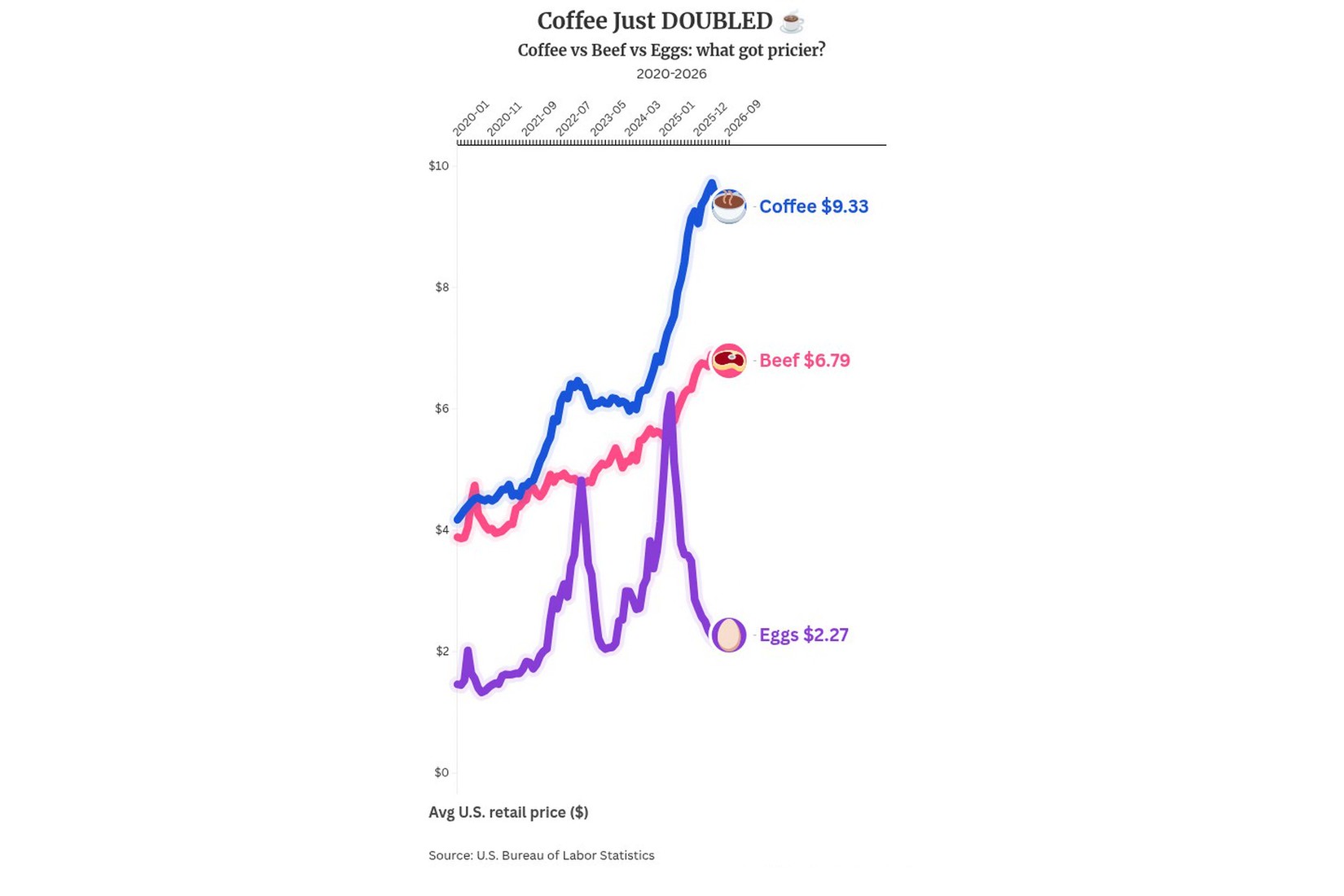
Line chart of average US prices for coffee, ground beef and eggs, January 2020 to September 2026.
Coffee more than doubled
Take a sec and guess: a pound of ground coffee cost about $4.17 in January 2020. What do you think it cost in September 2026? Got your number? Read on.
Ground coffee went from about $4.17 a pound in January 2020 to $9.33 in September 2026, a 124% jump, and that’s down slightly from its record $9.72 in April 2026. It’s the biggest climb of the three.
Beef hit a record high
Ground beef rose from $3.89 a pound in January 2020 to $6.79 in September 2026, after hitting a record $6.92 in August 2026.
Eggs spiked, then cooled
A dozen eggs went from $1.46 in January 2020 to a peak of $6.23 in March 2025, and have since fallen back to about $2.27.
Why breakfast got pricier: farms, weather and inflation
Those price lines didn’t move by themselves. Behind each one there’s a story from a farm, a pasture or a coffee field. Here’s what drove each staple, straight from USDA and other official sources.
Coffee: dry weather in the world’s biggest growers
Brazil grows nearly 40% of the world’s coffee, and drought and high temperatures there cut both arabica and robusta yields in 2024. Vietnam, the top robusta grower, had its own drought-and-heat losses the year before (USDA Foreign Agricultural Service). The result: the International Coffee Organization’s benchmark price averaged 306.6 cents a pound in 2024/25, up 52% in a single year (ICO). Tariffs added pressure too. An extra 40% U.S. duty on many Brazilian goods arrived in mid-2025, and coffee wasn’t exempted until November 2025 (White House).

Beef: the smallest cattle herd since 1951
Cattle can’t be rushed. Drought dried out pastures and sent hay prices to records, so ranchers sold off cows instead of feeding them (USDA ERS). By January 2026 the U.S. had just 86.2 million cattle and calves, the fewest since 1951 (USDA NASS). Imports of Mexican cattle were also halted in 2025 over the New World screwworm pest. Border ports only began reopening in stages in August 2026 (USDA APHIS), and USDA still expects retail beef prices to rise 9.4% this year (USDA ERS).

Eggs: bird flu emptied the henhouses
Highly pathogenic avian influenza has hit U.S. flocks since 2022. Between mid-October 2024 and early March 2025 alone, 50.7 million egg-laying hens were lost (USDA ERS). Fewer hens meant fewer eggs and that $6.23 peak. As flocks were rebuilt and new outbreaks slowed in early 2026, prices fell fast: USDA forecasts retail eggs down 29.4% for 2026 (USDA ERS Food Price Outlook).

And everything else: inflation
It isn’t just breakfast. The government’s grocery price index is about 32% higher than it was in January 2020 (BLS). The biggest jump came in 2022, when food prices rose 9.9%, the fastest pace since 1979, fueled by bird flu, the war in Ukraine and high energy costs (USDA ERS). The good news: grocery inflation has cooled to 1.8% over the past year (BLS, September 2026).

What it means for your kitchen
Coffee and beef are the budget squeezers right now. Eggs are still a relatively cheap protein, so breakfasts like my 2-minute egg in a mug are a smart swap.
Source: US Bureau of Labor Statistics average price data (series APU0000717311, APU0000703112, APU0000708111), through the September 2026 CPI release.
Your turn: which breakfast staple hit your wallet hardest, coffee, beef or eggs? And did you change anything, like brewing at home or switching proteins? Tell us in the comments!
Leave a Reply